Pages

Showing posts with label SEL. Show all posts

Sunday, November 6, 2016

Nerdy Birdy


Nerdy Birdy, written by Aaron Reynolds and illustrated by Matt Davies, was the first book we read in our classroom this year.  The theme of inclusion is an essential element for building a classroom community.  In the story, the main character, Nerdy Birdy, doesn’t fit in with the “cool” birdies.  While they are busy hunting, eating worms, and posing, Nerdy Birdy is busy reading and playing “World of Wormcraft”.  Nerdy Birdy is lonely and the cool birdies make him feel like an outsider.  That is, until he meets the other nerdy birdies,  They invite him to join because “there’s always room for another nerdy birdy”.  Then, Vulture moves in.  Nerdy Birdy invites him to hang out with the other nerdy birdies, but they quickly start questioning whether Vulture belongs with them.  Nerdy Birdy faces a dilemma: stay with his new-found friends or befriend Vulture?  Remembering how it feels to be alone, Nerdy Birdy chooses a friendship with Vulture.  Even though they do not have everything in common, they find common ground in their friendship.  And they always have room for another birdy.

This book fits perfectly into any Social Emotional Learning curriculum.  It celebrates individuality and promotes an inclusive community.  Nerdy Birdy also models how to be an “upstander” by standing up for what is right, even if it means being alone.  We plan to loop back to this story at the end of the year with a reread and our very own "Nerdy Birdy" class picture, where each child comes to school dressed to show their true colors and interests. It is sure to be a great send off and a sweet memento aimed to remind them to embrace everyone and be true to themselves.

Nerdy Birdy also has multiple opportunities to re-visit as a mentor text for the writers in your classroom.  The use of dialogue in the book is a good transition from speech bubbles into traditional use of quotation marks.  We like to use graphic novels and comics to help the students see what belongs inside of the quotation marks.  In Nerdy Birdy, the dialogue is written inside quotation marks, but is right next to the character similar to a speech bubble.  There is also an opportunity to look at how to use non-fiction text features in fiction storytelling.  The book has multiple diagrams, lists, and labels used to convey information about the characters.  It’s a great example of how authors and illustrators play with the elements of fiction and non-fiction and an excellent invitation to growing writers to blend elements in their own writing and illustrating.  

Mentor Text Ideas: dialogue, text features, SEL

Wednesday, July 13, 2016

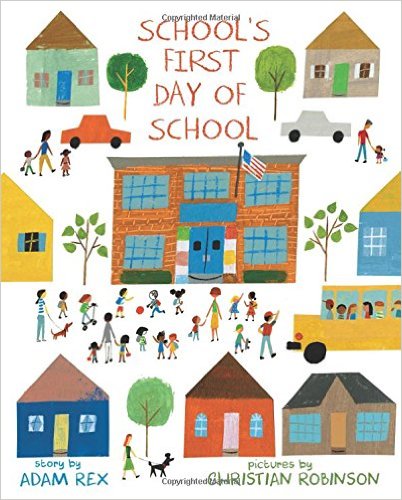
School's First Day of School

5140WLWHiLL._SX400_BO1,204,203,200_.jpg
School’s First Day of School, by Adam Rex is a great way to start the year! First of all, we should begin with how much we love Adam Rex! He is an interesting, clever, and funny guy, and we use many of the books he writes and illustrates as mentor texts inside our reading and writing workshops.  His website is full of information sure to entertain you on its own! In School’s First Day of School, he partners with illustrator Christian Robinson, whose most recently illustrated Last Stop on Market Street, which received a Caldecott Honor. Robinson’s simplistic illustrations provide an accessible style for children to replicate. His books are great mentor texts in the classroom to use when illustrating their own books!

School’s First Day of School tells the story from the perspective of a brand new school brought to life with illustrations personifying the front of the school. Robinson’s thoughtful subtlety allows readers to make these discovery of the School's face on their own, which we know children love to do! The story will connect to any child (or teacher!) who experiences anxiety a new school year often creates, which makes for a great SEL lesson!  Robinson’s acrylic and collage illustrations reflect a beautifully diverse student body and follows a small freckled girl as she conquers her anxiety before the last pages turn. Rex creates a story with a very real plot for children, and he does it with perfectly placed jokes to give readers something to consider and a reason to laugh!  Perhaps the most heartwarming relationship is between School and Janitor. Janitor plays a nurturing role as he calms School’s anxiety before school starts. He is the expert in all things “school”, and he lovingly takes care of School to make it a special place for the children and teachers- Just like Ms. Norma and Ms. Nicolasa (a special shout out to our special friends who take such great care of our classrooms!)

Rex creates a story full of School’s internal dialogue, which is something we encourage our young writers to use in their stories. Internal dialogue mirrors real life, which creates voice and authenticity. Using internal dialogue is an effective way to elaborate, and it gives readers details they can’t acquire any other way. The collaborative work between author and illustrator make this book a great tool to use with children who want to try on personification and perspective as they write.
-- A must have for the beginning of the year!

Mentor Text Ideas: internal dialogue, perspective, personification,

Thursday, March 31, 2016

Little Tree


Teaching gives us the great pleasure of reaching out to young learners who are vastly different from one another. Some of our students are bold and confident, while others are more cautious and avoid risks at most costs. Little Tree, by Loren Long, will connect to your risk averse students by introducing them to a forest full of trees and animals whose diverse personalities mirror the students in our own classrooms.. Some trees immediately grow and change without fear or prodding. However, Little Tree enjoys life just as it is. He loves his little forest and the way his leaves cool him in the heat of summer. He wants things to stay the same, so when the seasons change, Little tree holds tightly to his leaves when all of the other trees begin to lose their foliage. He is afraid. Through thoughtful use of dialogue (in all of the ways we teachers want to help students use dialogue), the forest animals encourage Little Tree to drop his leaves so he can grow.  Careful placement of ellipses across pages invite page turns, which is sure to inspire young writers to try on this feature in their own writing. As seasons come and go, Little Tree resists dropping his leaves. As he does, he is unable to grow in the “just right” ways trees grow. Will Little Tree drop his leaves and take a risk in order to reach his full potential? Little Tree is a great SEL (Social Emotional Learning) book building and maintaining a safe learning community for learners.

Mentor Text Ideas- Ellipses; SEL; Dialogue